This project has sound that autoruns, so you will need to view the actual page it is in to see it. If you are on the blog's frontpage, click cont below:
Showing posts with label Home Education. Show all posts
Showing posts with label Home Education. Show all posts


Buntle Hunter Ass Kickin
Originally Buntle Hunter was supposed to be the antagonist of these odd
creatures, but when I imported him into the animation file with the
others he was tiny!
So rather than change that I rolled with it and it shaped the animation.
So rather than change that I rolled with it and it shaped the animation.
Also EyeStalk has glasses in this one, just cos.
What do you think it needs?
What do you think it needs?
Optimistic Post #1 :: Professor Dawkins
Richard Dawkins is optimistic about four things in his chapter of What Are You Optimistic About.

Prof Dawkins is optimistic that humans will find The Theory of Everything before aliens arrive.
The second thing he is optimistic about is that with The Theory of Everything we will then complete physics, but the enterperise of physics will continue.
With evolution by natural selection and The Theory of Everything we will create a sensible explanation for the existence of humans and the universe.
Prof Dawkins is confident that this will deal a deathblow to religion. I think this is unlikely, but if no people believed this, then they wouldn't have so much belief in science.

Prof Dawkins is optimistic that humans will find The Theory of Everything before aliens arrive.
The second thing he is optimistic about is that with The Theory of Everything we will then complete physics, but the enterperise of physics will continue.
With evolution by natural selection and The Theory of Everything we will create a sensible explanation for the existence of humans and the universe.
Prof Dawkins is confident that this will deal a deathblow to religion. I think this is unlikely, but if no people believed this, then they wouldn't have so much belief in science.
Non-Fiction Book Roundup 2011
Partial Non-Fiction Book Roundup 2011
Here are some of the non fiction books I have read this year, which I recommend for one reason or another. A good practice, imo, with any new idea, thinker, theory, or whatever is to read what is being said in criticism of it. To that end, I have added (MCR) links which point to the most critical review I could find, or a list of critical reviews.
1 History of Western Philosophy
2 Guns Germs and Steel
3 Consilience
4 Holographic Universe
5 Critical Mass
6 Black Swan
7 How the Mind Works
8 Emergence
9 Rubicon
10 Meme Machine

The History of Western Philosophy
The History of Western Philosophy is a daunting book, but once you start reading it you realize why it is so highly regarded. This is a history of thinkers, and the schools and religions they influenced, and it sheds light on many forgotten but important forerunners of the memes and ideas that fill our heads now.
Russell's writing style inspires confidence in his integrity. I never once got the impression that he was trying to push his own agenda or beliefs, even in the Christian chapters. He simply lays the
subject matter out and chapter by chapter you learn huge important chunks of how Western societies got where they are, and think the way they think. It is such foundational material that I am rather annoyed that my school did not get me reading this as a boy instead of the bible. My boys read small snippets of this, mostly when I prompt them to. I always emphasize that it is a book to go to for short passages, rather than something they should read cover to cover.
Sometimes - not often at the time of writing this - we just use it a text for reading aloud. It is not essential to understand it all at any particular stage, just getting exposed to the words and ideas within is educational. MCR

Guns, Germs and Steel
Another fascinating, but sometimes difficult to read book. The difficulty in this case is that some parts go into great detail and you end up asking yourself whether you really need to know all this, but Diamond has several fascinating points to make and prove, and these points are worth struggling through the drier passages.
Why did some areas of the planet produce and support societies that exported amazing *cargo*
Why did some areas of the planet produce and support societies that exported amazing *cargo*
and other areas produce societies that are still firing arrows to catch their food, and in need ( or
desirous of ) that fantastic cargo.
Why did a tiny contingent of Europeans conquer so much territory, people and plunder so much, so easily from massive empires in the Americas? Read this book to find out, or watch the author give a lecture about it if you prefer - video is available online. MCR
Why did a tiny contingent of Europeans conquer so much territory, people and plunder so much, so easily from massive empires in the Americas? Read this book to find out, or watch the author give a lecture about it if you prefer - video is available online. MCR
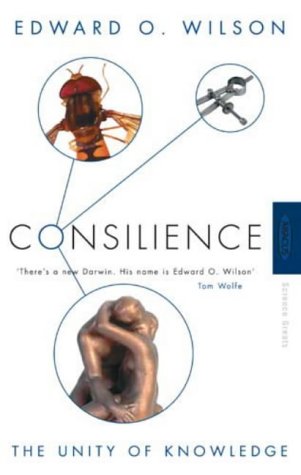
Consilience
The concept that this book teaches about means the 'Unity of Knowledge'. It is interdisciplinary-ness taken to the max, so I would read it even if it were awful in other ways, which it is not. Academia is famous for breaking knowledge into subjects, departments and territories, and this mode of thought flies in the face of that. For internet connected home educated kids and parents this would seem to be a good meta/subject to move into to take advantage of our greater freedoms.
One thing to note however, is that although some people online think very highly of Wilson's work, the writers of the three splurbs on the cover of my edition are all literary types, not scientific ones, whom would have perhaps been a more appropriate choice. On the other hand, maybe it takes literary types to see the broader projected picture in a positive light, as they are not constrained to one or other 'Great Branches of Learning'.
Consilience is definitely on my reread list, both the boys have read it, and I expect to read it with my grandkids, as the concept will still hold, I am sure. Which grandchild generation schoolkids will have heard of the concept by then? MCR
One thing to note however, is that although some people online think very highly of Wilson's work, the writers of the three splurbs on the cover of my edition are all literary types, not scientific ones, whom would have perhaps been a more appropriate choice. On the other hand, maybe it takes literary types to see the broader projected picture in a positive light, as they are not constrained to one or other 'Great Branches of Learning'.
Consilience is definitely on my reread list, both the boys have read it, and I expect to read it with my grandkids, as the concept will still hold, I am sure. Which grandchild generation schoolkids will have heard of the concept by then? MCR

Holographic Universe
This book takes a key scientific idea and expands and extrapolates to explain many bizarre
This book takes a key scientific idea and expands and extrapolates to explain many bizarre
phenomena in a logical way. Are our minds co-authors of the reality we 'perceive'? They certainly are, but to what level?
My whole family has marked this book for reading. If you are interested in spiritual and/or supernatural things the ideas contained in this book - once you get past the science bit at the start - might help you understand them, and see them in a whole different perspective.
At times I cannot help but wonder if the author is over working the base material, and using it to explain too many things. That other fascinating phenomena? Holographic! That unknown mystery? Holographic!
Nevertheless it remains an interesting read and one I will return to again because the theory does have explanatory power. The thing is, it has enormous explanatory power, or he is pretty wrong and has been conned.
I haven't looked up any online material critical of this book yet - for some reason I am holding off - but a theory of such great power needs skepticism and scorn poured all over, it needs to be tested, to see how well it holds under pressure. MCR - I guess I did look it up.
My whole family has marked this book for reading. If you are interested in spiritual and/or supernatural things the ideas contained in this book - once you get past the science bit at the start - might help you understand them, and see them in a whole different perspective.
At times I cannot help but wonder if the author is over working the base material, and using it to explain too many things. That other fascinating phenomena? Holographic! That unknown mystery? Holographic!
Nevertheless it remains an interesting read and one I will return to again because the theory does have explanatory power. The thing is, it has enormous explanatory power, or he is pretty wrong and has been conned.
I haven't looked up any online material critical of this book yet - for some reason I am holding off - but a theory of such great power needs skepticism and scorn poured all over, it needs to be tested, to see how well it holds under pressure. MCR - I guess I did look it up.

Critical Mass
I paid full price for this one, on a bad mood whim one time. As with Guns, Germs and Steel it has some parts that are slow going unless you happen to be interested in the actual material presented, but it is worth it for the greater points he is trying to make. Again it is multidisciplinary, and meta, the product of a great mind's years of trying to figure important trends out. It gets critiqued in the next book on this list. MCR

Black Swan
Wow! The safer(more stable) you feel, the less safe you are, because it is the extremely rare, unpredictable events that are likely to shape your life and society. The more you come to feel like you can predict the future - especially using as system based on numbers - the more vulnerable you are to a Black Swan event. ((Although a BS can be positive...))
This is mind blowing!
And how could I have never known the word 'erudite' before reading this?!? (It means well read, to save you a quick search)
Where some of these books are sometimes wordy and dry in a slow paced kind of way, this one is a footnoter, something which bothers me less. However I have decided to teach the idea of this book to my family verbally, myself, rather than strew this book heavily, or ask them if they want to read it.
I intend to read it again, possibly backwards by chapter, or at least the last few sections first as I did feel that as I reached the end, there was another bit , then another bit, and maybe the good author was saving the very best till the very end. Cheeky, but he doesn't give a damn I don't suppose, having earned a great deal of money by being extremely smart. He was also, interestingly, not whatever it-takes enough for TED, his talk having been *buried*.
I wonder if it will ever leak. If you find it, please post the link! MCR
This is mind blowing!
And how could I have never known the word 'erudite' before reading this?!? (It means well read, to save you a quick search)
Where some of these books are sometimes wordy and dry in a slow paced kind of way, this one is a footnoter, something which bothers me less. However I have decided to teach the idea of this book to my family verbally, myself, rather than strew this book heavily, or ask them if they want to read it.
I intend to read it again, possibly backwards by chapter, or at least the last few sections first as I did feel that as I reached the end, there was another bit , then another bit, and maybe the good author was saving the very best till the very end. Cheeky, but he doesn't give a damn I don't suppose, having earned a great deal of money by being extremely smart. He was also, interestingly, not whatever it-takes enough for TED, his talk having been *buried*.
I wonder if it will ever leak. If you find it, please post the link! MCR

How the Mind Works
I thought this one would be a boring run through of best/favourite articles of psychology, but stuff I had best brush up on, as I don't want to not know about something.
It was pretty much that, but less of the boring, and more interdisciplinary than I had expected. How can anyone not want to know this stuff? It's not on the school curriculum, and personally I don't care whether they adopt it, but it makes super easy reading of psychology, biology; when textbooks of those subjects are overweight, overpriced and an upgrade and often exam board con. Great for someone like...home educators with extra learning freedoms. If your kids want to specialize, those textbooks and college classes will still be there. Unless of course, they have become obsolete by then.
I don't think this book will have become obsolete, although it does have an updated version from mine. We have purchased another of Pinker's books, but have not read it yet, and his latest looks interesting too, arguing the the total cruelty of the human race has gone down. A recommended read, a recommended thinker. If you disagree, I'd love to hear about it. MCR
It was pretty much that, but less of the boring, and more interdisciplinary than I had expected. How can anyone not want to know this stuff? It's not on the school curriculum, and personally I don't care whether they adopt it, but it makes super easy reading of psychology, biology; when textbooks of those subjects are overweight, overpriced and an upgrade and often exam board con. Great for someone like...home educators with extra learning freedoms. If your kids want to specialize, those textbooks and college classes will still be there. Unless of course, they have become obsolete by then.
I don't think this book will have become obsolete, although it does have an updated version from mine. We have purchased another of Pinker's books, but have not read it yet, and his latest looks interesting too, arguing the the total cruelty of the human race has gone down. A recommended read, a recommended thinker. If you disagree, I'd love to hear about it. MCR

Emergence by Steven Johnson
How does the greater, excellent thing, emerge from a multitude of much smaller, basic units? I was intrigued to find out that bits in this book felt dated, but I am glad to have bought and read it, as it what feels like dated knowledge to me is still great for the kids.
The History of Western Philosophy is dated too, but it's position in the canon of English language head coffee is assured. Emergence is an important concept, this is the book about it. It goes far beyond the wikipedia article on the subject.
I guess more knowledge about it will groans you know, emerge. MCR
The History of Western Philosophy is dated too, but it's position in the canon of English language head coffee is assured. Emergence is an important concept, this is the book about it. It goes far beyond the wikipedia article on the subject.
I guess more knowledge about it will groans you know, emerge. MCR
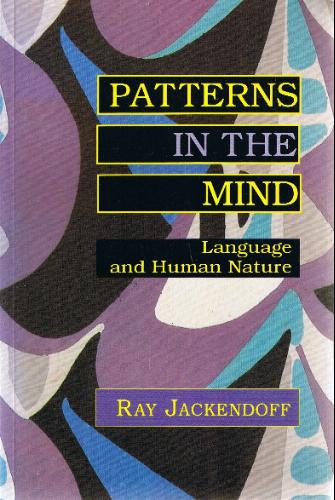
Patterns in the Mind
Linguistics is one of those subjects which a greater understanding of, enables a greater understanding of other areas, in this case, music appreciation, cultural, and social interaction. I doubt many want however to read Chomsky's linguistics works in the original, well Jackendoff provides the overview. He also provides, as a basis, another competing theory.
Generative Grammar vs Innate Knowledge then, form an axis on which to hang this study, but the author goes further, adding a third and also sections on how children learn, and how language can be acquired under odd circumstances.
I've yet to come across a book on semiotics as good as this one is for linguistics. MCR
Generative Grammar vs Innate Knowledge then, form an axis on which to hang this study, but the author goes further, adding a third and also sections on how children learn, and how language can be acquired under odd circumstances.
I've yet to come across a book on semiotics as good as this one is for linguistics. MCR

Rubicon
Rome was already great before it was an Empire. In fact the Roman Republic is even more interesting in my opinion. This society did not want anyone to climb too high! They were ever afraid of a tyrant arising from within and gaining too much power. Despite this they kicked major ass and held dominion over a large area, all without a particularly distincitve culture of their own. This book takes an important era of history and teaches you about it in a way that is as gripping as a good novel, whilst reminding us that historical truth may not be all that truthful.
A fantastic learning experience for a home educated kid, is to read this book over the same period as playing the pc game Rome: Total War as one strand will fertilize the other, and mental links will be made. There is, of course, plenty of other material that falls into this period, but we found that these two went brilliantly together.
Studying Classical Civ has an unassailable feel to it as well; no one is going to diss your child for studying this, it contains our world in retrocosm. While we're on the subject, we learn Latin and ancient Greek words, but not much of written or spoken language. This informs the use of modern language without getting bogged down in learning a virtually useless dead tongue.
Rubicon rules, I want this authors other book too. Both boys read it, and will certainly read it again, I guess so our faction is better able to ... no wait that's the game! MCR lol

The Meme Machine
Why do I read books like the ones in this list? Partly because I want to know things, especially things that might prove useful, but also things that help me to better understand the world, universe and people.
But also because I am responsible for educating my kids, and humans learn by copying. I want my boys to see me reading these books, and see me punch the sky when I finish one or grok something.
They have already started practicing the reading meme and I want them to also get the reading smart stuff meme so I have to do it first.
This book describes natural selection and how this applies to more than just physical organisms but their thoughts possessions and behaviours. Susan Blackmore is onto Richard Dawkin's meme concept with a view to pushing it outwards and trying to see things from a meme's eye view.
She has also coined a new term, the teme, which is another extraordinary concept, and well worth learning about. She has an excellent TED talk which you can look up to get the overview from, her book is worth reading and digesting. Mine is falling apart. MCR
But also because I am responsible for educating my kids, and humans learn by copying. I want my boys to see me reading these books, and see me punch the sky when I finish one or grok something.
They have already started practicing the reading meme and I want them to also get the reading smart stuff meme so I have to do it first.
This book describes natural selection and how this applies to more than just physical organisms but their thoughts possessions and behaviours. Susan Blackmore is onto Richard Dawkin's meme concept with a view to pushing it outwards and trying to see things from a meme's eye view.
She has also coined a new term, the teme, which is another extraordinary concept, and well worth learning about. She has an excellent TED talk which you can look up to get the overview from, her book is worth reading and digesting. Mine is falling apart. MCR
Paint your own Gorilla
We uploaded a blank Gorilla .blend under a CC license so you can use Blenders texture paint to decorate your own.

Don't forget to save out the image as well as the blender file itself. You can do this in the UV image window with Image>Save As. There are more instructions in the on hosting site, and inside the .blend file itself
Here is the Blend.

Don't forget to save out the image as well as the blender file itself. You can do this in the UV image window with Image>Save As. There are more instructions in the on hosting site, and inside the .blend file itself
Here is the Blend.
Some Home Education Resources Aug 2011
Some emphasis on being free (price) and freedom, as in free software.
Khan Academy - Maths and other tutorials.
Mathworld
Math visualizations.
Blender - Animation and image creation, video editing, game creation.
GIMP - Raster graphics.
Audacity - Sound editing.
Charity book shops.
Unity3d - Game making tool, free as in free beer.
topdocumentaryfilms Contains some adult/PG material.
Lately we've been enjoying the short educational videos on the abchungrybeast channel.
Soundcloud and Mixcloud for discovering new music.
Frontcannon/swinghouse-mix/
Amazing music genre/playlist for improving the mood in a room or person. Powerful stuff this. I can imagine WW3 breaking out and I will be tapping my foot with "Swing, swing, swing, swing..." running through my head.
http://www.ektoplazm.com/
Free motivational music.
Selected twitter, youtube, wikipedia and google channels/files/services depending on your interest. Always check if someone has uploaded a video when you get interested in something. Just about any music is available on youtube.
Total War games, in conjunction with other historical media, for learning history. Non free software but great fun, which is useful for history.
Wikireader Wikipedia in your pocket.
SAS Survival Handbook - in case the Predators arrive. You will also need mud, and a chopper to get to.
Academicearth - alternatively, you could go massively into debt to attend college.
TED There is a lot more here than that video.
Keiser Report
Business, markets and political analysis videos with Max Keiser and Stacy Herbert.
http://www.reddit.com/r/videos Lulz, culture etc. Pick through em when your kids are playing outside, for watching later on. (I mean that, some adult content)
Okami for the Wii Sheer beauty, student pacification.
Update: Check out Suzie's Tutorials.
This is a current list, see also the sidebars on this blog. Please contact me with any other suggestions, cool links etc. This post is part of a Home ed resources carnival, started by Jax. Check out the other lists.

Khan Academy - Maths and other tutorials.
Mathworld
Math visualizations.
Blender - Animation and image creation, video editing, game creation.
GIMP - Raster graphics.
Audacity - Sound editing.
Charity book shops.
Unity3d - Game making tool, free as in free beer.
topdocumentaryfilms Contains some adult/PG material.
Lately we've been enjoying the short educational videos on the abchungrybeast channel.
Soundcloud and Mixcloud for discovering new music.
Frontcannon/swinghouse-mix/
Amazing music genre/playlist for improving the mood in a room or person. Powerful stuff this. I can imagine WW3 breaking out and I will be tapping my foot with "Swing, swing, swing, swing..." running through my head.
http://www.ektoplazm.com/
Free motivational music.
Selected twitter, youtube, wikipedia and google channels/files/services depending on your interest. Always check if someone has uploaded a video when you get interested in something. Just about any music is available on youtube.
Total War games, in conjunction with other historical media, for learning history. Non free software but great fun, which is useful for history.
Wikireader Wikipedia in your pocket.
SAS Survival Handbook - in case the Predators arrive. You will also need mud, and a chopper to get to.
Academicearth - alternatively, you could go massively into debt to attend college.
TED There is a lot more here than that video.
Keiser Report
Business, markets and political analysis videos with Max Keiser and Stacy Herbert.
http://www.reddit.com/r/videos Lulz, culture etc. Pick through em when your kids are playing outside, for watching later on. (I mean that, some adult content)
Okami for the Wii Sheer beauty, student pacification.
Update: Check out Suzie's Tutorials.
This is a current list, see also the sidebars on this blog. Please contact me with any other suggestions, cool links etc. This post is part of a Home ed resources carnival, started by Jax. Check out the other lists.
Arty Bristol Gorillas
For the past few weeks Bristol has had a number of artistically painted Gorilla statues placed all over the city.
People have been taking photos of them, and we went on a Home Ed trip to collects some pics too.
Here is our pic set.
The gorillas made us want to paint our own in 3d as a group project and here they are.
People have been taking photos of them, and we went on a Home Ed trip to collects some pics too.
Here is our pic set.
The gorillas made us want to paint our own in 3d as a group project and here they are.
Splat Splash
This is the sixth or seventh attempt my brother and dad have had at rendering this scene. It has taken quite a lot of time and effort to make this one, compared to our other animations.
Still a Work in Progress Here
So I've been having a go at twitter recently, and have come across some interesting people, and great links.
One of the blogs I'm now following is Live Otherwise. Jax, the owner has made a badge for a certain kind of post, and I thought we could work with that, in our own kind of way.
Changes are going on around us. Winter is coming, there are rounds of layoffs at Xerrens work, the Ponzi scheme that is the UK economy continues to suck the life out of the people. Our cats are hunting more, and keeping it outside. There is another set of concerns that the government will change the laws surrounding home education, another set of people trying to create a new Mayor role for our city.
At the moment, we are staying the course. We are succeeding in our goals with our lives, even if we are not making heaps of money out of it yet, so for us it's a case of keep going, keep trying out new things; but mostly keep doing the things we know are good, and keep trying to do them better.
Living Otherwise!
One of the blogs I'm now following is Live Otherwise. Jax, the owner has made a badge for a certain kind of post, and I thought we could work with that, in our own kind of way.
Changes are going on around us. Winter is coming, there are rounds of layoffs at Xerrens work, the Ponzi scheme that is the UK economy continues to suck the life out of the people. Our cats are hunting more, and keeping it outside. There is another set of concerns that the government will change the laws surrounding home education, another set of people trying to create a new Mayor role for our city.
At the moment, we are staying the course. We are succeeding in our goals with our lives, even if we are not making heaps of money out of it yet, so for us it's a case of keep going, keep trying out new things; but mostly keep doing the things we know are good, and keep trying to do them better.
Living Otherwise!
Mesh Bottle

Apparently the trick is to use a shrink wrap modifier on the mesh, so that it becomes bottle shaped.
Retrieving Biro with HE Illumination
An unexpected turn to todays Home Education.
While tidying up, a biro fell down the back of the gas fire we have, landing inside, a few inches down, on a platform:

After a few moments trying to even see the damn thing, and a few more testing the fire itself for usefulness, I got to work on getting the pen out, with the help of my son, who I sometimes refer to as AchillesX.
That might melt, and stink, and give out poisonous particles when we next turn the fire on I explain to AchillesX, who is asking why am I bothering.
The pen:
Why do we even own one of these vile things? I have switched over to digital text or pencil almost entirely now. All biros are good for is signing bank cards.
We made some tools:

The red thing is a cardboard chute, which would catch the pen and guide it out.
The two copper wires are supposedly Art Stuff, as you can see from the wavyness. These were bent into various shapes to move the pen (painstakingly) along the platform it was on, and align it with the cardboard.
Fretting that we have no working torch in our house atm, I told AchillesX to make me one; that is the simple circuit you can see in the pic there. It was essential, as my phone screen would not cast enough light for me to see what was going on.
It took quite a while, and we had to stop for food, and to remain calm, and physically comfortable, as this task required an awkward body position.
Dammit pen I WILL HAVE YOU!!!
Remain calm. Zen Like. Repeat the procedure.
CaesarX is in the other room, rigging an Odd Creature, listening to Bear McCreary.
Eventually, I got the pen onto the chute, tilted and pulled it out. Success!

Anyway it made for a tense but rewarding half hour or so.
It made AchillesX laugh once we were done, and now a circuit he can build has actually become useful.
While tidying up, a biro fell down the back of the gas fire we have, landing inside, a few inches down, on a platform:

After a few moments trying to even see the damn thing, and a few more testing the fire itself for usefulness, I got to work on getting the pen out, with the help of my son, who I sometimes refer to as AchillesX.
That might melt, and stink, and give out poisonous particles when we next turn the fire on I explain to AchillesX, who is asking why am I bothering.
The pen:
Why do we even own one of these vile things? I have switched over to digital text or pencil almost entirely now. All biros are good for is signing bank cards.
We made some tools:

The red thing is a cardboard chute, which would catch the pen and guide it out.
The two copper wires are supposedly Art Stuff, as you can see from the wavyness. These were bent into various shapes to move the pen (painstakingly) along the platform it was on, and align it with the cardboard.
Fretting that we have no working torch in our house atm, I told AchillesX to make me one; that is the simple circuit you can see in the pic there. It was essential, as my phone screen would not cast enough light for me to see what was going on.
It took quite a while, and we had to stop for food, and to remain calm, and physically comfortable, as this task required an awkward body position.
Dammit pen I WILL HAVE YOU!!!
Remain calm. Zen Like. Repeat the procedure.
CaesarX is in the other room, rigging an Odd Creature, listening to Bear McCreary.
Eventually, I got the pen onto the chute, tilted and pulled it out. Success!

Anyway it made for a tense but rewarding half hour or so.
It made AchillesX laugh once we were done, and now a circuit he can build has actually become useful.
Blender Flying Saucer Tutorial Part 1
Insomnia!
I can't sleep, so I am writing a tutorial.
Create a project folder and name it. Go into it then create four more:

Set up two 3D viewports, put one in top, orthographic view. Do this by clicking View>Top, or on a full keyboard use the numpad keys 5 and 7.
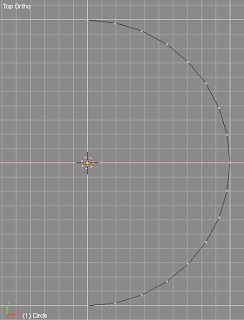
Now use Shift-A to add a mesh circle, accept at 32 vertices. Go into this objects edit mode with TAB. Use A once or twice to get all verts deselected, then use B to box select all the verts on the left of the centerline. Once these verts are selected, delete them with X > ENTER.
Check out every detail of Pic 2 a moment. Its in Top Ortho view, and you can see at the bttom that from this view the y axis is 'up down' and the x axis is 'left right'. Save your file quickly with CTRL-W. Put it in the 'blends' folder you created. Now notice in Pic 2 the big yellow dot. This is the circle objects pivot point. If you select the circle, or all the verts in edit mode, then hit R, it will all rotate around that. Around the yellow dot is the cursor, which functions just like a cursor does in a word processor. You put it where you want to create new objects.
Undo any rotations with CTRL-Z or reload the file you just saved File > Open Recent.
In the buttons window, editing panel, add a modifier or the type: Mirror. Enable 'Do Clipping'

Flip between Object and Edit mode a few times with TAB. Move a vert in edit mode, then try Object mode to see what happens. Undo or reload to return again to the circle. Mirror mode enables you to model one half of a symmetrical object, and have the mirrored half follow along by itself. It's mostly used in character animation, but we have one here as well.
In edit mode:
Change the objects pivot from median point, to 3d Cursor, then hit A to select all verts, click 'only edges', then hit S to scale the verts/edges inwards as in Pic 4.

Next tilt the 3D viewport a bit, and move the inner loop of verts up a bit. You can either drag the blue arrow up, or use G, Z, Drag, ENTER.
Now repeat the process of extruding, constraining to axis (X,Y,Z) translating with G and scaling with S to give your saucer a better shape.
Don't forget to use two 3D viewports. Tilt one around, and keep the other in Orthogonal top, front or side view.
Save your file.
Now experiment with the tools we've use so far.
This is where your saucer can and should start to look a bit different to my one.
Bear in mind that scaling is done around the cursor, as it is currently set so you might find scaling verts also drags them down in the z axis towards the cursor. This can be undesirable so select only the top and bottom verts, then snap the cursor to a point between them with Shift-S > cursor to selection

You can select the outer loop of verts with alt-select to extrude that. Note: if you use the Gnome Desktop Manager then alt-select may not work. Instead, select two of the verts in the loop you want to select, then hit CTRL-E > Edge Loop Select.
You can seal the hole by selecting the two verts at the tope and bottom of it, snaping the cursor there with Shift-S > Cursor to Selection, then extruding with E, and merging the verts with W Merge > At cursor.
One useful trick here is to hit TAB to get the Saucers Object mode, then hit Shift-D then Z, drag, enter. This will duplicate, and drag across a copy which you can then experiment on alongside the original.

One basic setting is set smooth/set solid. This is a toggle between a basic smooth look, and a basically chunky, solid one. There are buttons in the edit panel, under link and materials. Another way to swap between them is in edit mode with the W menu > Set Smooth OR W > Set Solid.
The reason I mention this now is it also brings to the fore a common problem. If set smooth makes the model look ugly, you probably have a 'normals' problem. Go into edit mode, select all verts with A, then hit CTRL-N > Recalculate Normals. I advise that you keep modelling for a while, and delay researching normals further for now. Once you know this technique, that is adequate knowledge about normals for now.
Try to make sure you close both the top and the bottom of your saucer.
Don't forget to give your saucers objects a material each, and a decent name. To rename one, select it, then hit N. Click in the text field where it says Circle, or Circle.001 and type 'Saucer' or something descriptive.
When you feel 'done' change the pivot type back to median before you save your file, as this is the 'norm', and the best way to leave it.
One final tip. Lets indent a panel, or make a hatch. Select a saucer, hit Alt-Tab to and select Faces. Now you select whole faces in edit mode, rather than verts or edges. Select a face, then hit E to extrude it, and accept immediately, without moving it around. Now use S to scale it in a little.
Now change the transform orientation to 'Normal' as below, or with Alt-Space > Normal.

Now extrude again, but this time drag it down and/or into he ship, as in pic.
Notice how this makes two indented panels/hatches because you are still using a mirror modifier. You can 'apply' the mirror modifier if you wish, to get rid of it, and make the saucer a single whole mesh.
Adding a decal.
Select an area of the mesh, in faces. Snap the cursor there: Shift-S > Cursor to Selection. Go into object mode, and add an 'Empty' with Shift-A > Add Empty. With this still selected, Shift select the saucer as well, then hit CTRL-P > Make Parent.
On the saucers shader/material panel, add a texture, choose type image, then CTRL-click LOAD and find a decal image. Make sure you press ClipCube, as in the image.
Now go from the texture buttons back to the materials buttons, and change the Map Input settings. Select Object, and type 'Empty' in the text field there. You may need to change the size settings; you can see I have made them all 10.

The result:

This is a cool technique. In my example, I don't find it all that aesthetically pleasing, so I think it should be changed into a weird alien symbol rather than my 'Happy Avatar', or perhaps...
 ...he needs a window frame...
On second thoughts, he doesn't really belong on this model, so I'll replace the image with a toned down version

Thats all for this part, I must try and sleep. This render has texture spread over the entirety of each model. Music made in Reason 4.
Watch Flying Saucers in Animation | View More Free Videos Online at Veoh.com
I can't sleep, so I am writing a tutorial.
Create a project folder and name it. Go into it then create four more:


Set up two 3D viewports, put one in top, orthographic view. Do this by clicking View>Top, or on a full keyboard use the numpad keys 5 and 7.
Now use Shift-A to add a mesh circle, accept at 32 vertices. Go into this objects edit mode with TAB. Use A once or twice to get all verts deselected, then use B to box select all the verts on the left of the centerline. Once these verts are selected, delete them with X > ENTER.
Check out every detail of Pic 2 a moment. Its in Top Ortho view, and you can see at the bttom that from this view the y axis is 'up down' and the x axis is 'left right'. Save your file quickly with CTRL-W. Put it in the 'blends' folder you created. Now notice in Pic 2 the big yellow dot. This is the circle objects pivot point. If you select the circle, or all the verts in edit mode, then hit R, it will all rotate around that. Around the yellow dot is the cursor, which functions just like a cursor does in a word processor. You put it where you want to create new objects.
Undo any rotations with CTRL-Z or reload the file you just saved File > Open Recent.
In the buttons window, editing panel, add a modifier or the type: Mirror. Enable 'Do Clipping'

Flip between Object and Edit mode a few times with TAB. Move a vert in edit mode, then try Object mode to see what happens. Undo or reload to return again to the circle. Mirror mode enables you to model one half of a symmetrical object, and have the mirrored half follow along by itself. It's mostly used in character animation, but we have one here as well.
In edit mode:
Change the objects pivot from median point, to 3d Cursor, then hit A to select all verts, click 'only edges', then hit S to scale the verts/edges inwards as in Pic 4.

Next tilt the 3D viewport a bit, and move the inner loop of verts up a bit. You can either drag the blue arrow up, or use G, Z, Drag, ENTER.
Now repeat the process of extruding, constraining to axis (X,Y,Z) translating with G and scaling with S to give your saucer a better shape.
Don't forget to use two 3D viewports. Tilt one around, and keep the other in Orthogonal top, front or side view.
Save your file.
Now experiment with the tools we've use so far.
This is where your saucer can and should start to look a bit different to my one.
Bear in mind that scaling is done around the cursor, as it is currently set so you might find scaling verts also drags them down in the z axis towards the cursor. This can be undesirable so select only the top and bottom verts, then snap the cursor to a point between them with Shift-S > cursor to selection

You can select the outer loop of verts with alt-select to extrude that. Note: if you use the Gnome Desktop Manager then alt-select may not work. Instead, select two of the verts in the loop you want to select, then hit CTRL-E > Edge Loop Select.
You can seal the hole by selecting the two verts at the tope and bottom of it, snaping the cursor there with Shift-S > Cursor to Selection, then extruding with E, and merging the verts with W Merge > At cursor.
One useful trick here is to hit TAB to get the Saucers Object mode, then hit Shift-D then Z, drag, enter. This will duplicate, and drag across a copy which you can then experiment on alongside the original.

One basic setting is set smooth/set solid. This is a toggle between a basic smooth look, and a basically chunky, solid one. There are buttons in the edit panel, under link and materials. Another way to swap between them is in edit mode with the W menu > Set Smooth OR W > Set Solid.
The reason I mention this now is it also brings to the fore a common problem. If set smooth makes the model look ugly, you probably have a 'normals' problem. Go into edit mode, select all verts with A, then hit CTRL-N > Recalculate Normals. I advise that you keep modelling for a while, and delay researching normals further for now. Once you know this technique, that is adequate knowledge about normals for now.
Try to make sure you close both the top and the bottom of your saucer.
Don't forget to give your saucers objects a material each, and a decent name. To rename one, select it, then hit N. Click in the text field where it says Circle, or Circle.001 and type 'Saucer' or something descriptive.
When you feel 'done' change the pivot type back to median before you save your file, as this is the 'norm', and the best way to leave it.
One final tip. Lets indent a panel, or make a hatch. Select a saucer, hit Alt-Tab to and select Faces. Now you select whole faces in edit mode, rather than verts or edges. Select a face, then hit E to extrude it, and accept immediately, without moving it around. Now use S to scale it in a little.
Now change the transform orientation to 'Normal' as below, or with Alt-Space > Normal.

Now extrude again, but this time drag it down and/or into he ship, as in pic.
Notice how this makes two indented panels/hatches because you are still using a mirror modifier. You can 'apply' the mirror modifier if you wish, to get rid of it, and make the saucer a single whole mesh.
Adding a decal.
Select an area of the mesh, in faces. Snap the cursor there: Shift-S > Cursor to Selection. Go into object mode, and add an 'Empty' with Shift-A > Add Empty. With this still selected, Shift select the saucer as well, then hit CTRL-P > Make Parent.
On the saucers shader/material panel, add a texture, choose type image, then CTRL-click LOAD and find a decal image. Make sure you press ClipCube, as in the image.
Now go from the texture buttons back to the materials buttons, and change the Map Input settings. Select Object, and type 'Empty' in the text field there. You may need to change the size settings; you can see I have made them all 10.

The result:

This is a cool technique. In my example, I don't find it all that aesthetically pleasing, so I think it should be changed into a weird alien symbol rather than my 'Happy Avatar', or perhaps...

On second thoughts, he doesn't really belong on this model, so I'll replace the image with a toned down version

Thats all for this part, I must try and sleep. This render has texture spread over the entirety of each model. Music made in Reason 4.
Watch Flying Saucers in Animation | View More Free Videos Online at Veoh.com
Slurrrppp
Odd Creatures from ShogunX G on Vimeo.
Odd Creatures from our 'Odd Characters' folder. Made with Blender, Audacity and Reason 4.
Made by my son AchillesX, and myself, part of our Home Education
This one took a couple of weeks, off and on.
AchillesX : Design, modelling, rigging, vocals, sequencing
ShogunX : Rigging tweaks (IK, Stride), animation, sequencing
EyeBall Creature
This is a creature that CaesarX and I made this week. Quite a few (ahem) steps were involved in this one.
Made in Blender 2.49 and Audacity. Animated and composited in Blender.
Eyeball Creature from ShogunX G on Vimeo.
Made in Blender 2.49 and Audacity. Animated and composited in Blender.
Eyeball Creature from ShogunX G on Vimeo.
Subscribe to:
Posts (Atom)


